Culture, according to Vijay Sathe is “the set of important understandings (often unstated) that members of a community share in common.” These shared understandings consist of our norms, values, attitudes, beliefs and ‘paradigms’.
Another definition given in Webster’s New Collegiate Dictionary – “culture is the integrated pattern of human behaviour that includes thought, speech, action, and artefacts and depends on man’s capacity for learning and transmitting knowledge to succeeding generations.” This second definition is an exciting one as increasing our capacity for learning and transmitting knowledge is one of the prime aims of Knowledge Management.
The Paradigm
The concept of the paradigm is an extremely important one in understanding culture. A paradigm is a way of thinking, perceiving, communicating or viewing the world. It is often called a worldview or a mindset. The important point about a paradigm is that it is subconscious. We are not aware of our own paradigms. Its a rather like thinking the world is coloured red – unaware that we are wearing rose tinted contact lenses. It is a frequently misunderstood and misused word. When someone says "we need a new paradigm for this." It is a misuse of the word. All they are saying is "we need a new approach or we need a new way of looking at things".
Organisational Culture
Organisational culture can be thought of as a relatively rigid tacit infrastructure of ideas that shape not only our thinking but also our behaviour and perception of our business environment. It effectively establishes a set of guidelines by which members of an organisation work and how those organisations are structured. It is rigid mainly due to our paradigms – we don’t recognise why we do so much of what we do. Also we tend to resist change rather than embrace it.
Knowledge and Information
Knowledge is often seen as a rich form of information. This differentiation however is not terribly helpful. A more useful definition of knowledge is that it is about know-how and know-why. A metaphor is that of a cake. An analysis of its molecular constituents is data – for most purposes not very useful – you may not even be able to tell it were a cake. A list of ingredients is information – more useful – an experienced cook could probably make the cake – the data has been given context. The recipe though would be knowledge – written knowledge - explicit knowledge – it tells you how-to make the cake. An inexperienced cook however, even with the recipe might not make a good cake. A person, though, with relevant knowledge, experience, and skill – knowledge in their heads - not easily written down - tacit knowledge – would almost certainly make an excellent cake from the recipe.
It is important to note that to make knowledge productive you need information. Knowing how to make a cake is not sufficient – you need the list of ingredients. And to decide what cake to make - you need information – the tastes of the consumers of the cake.
Know-why is also important. If an ingredient of the cake was unavailable – knowing the purpose of that ingredient might help a knowledgeable cook substitute an alternative. In fact know-why is often more important than know-how as it allows you to be creative - to fall back on principles – to re-invent your know-how.
Knowledge Management
There are many definitions of Knowledge Management. A common definition is ‘The collection of processes that govern the creation, dissemination, and leveraging of knowledge to fulfil organisational objectives.’ I feel this definition is inadequate, however, as it limits knowledge management to a set of processes. I prefer what I feel is a more useful definition: -
“Knowledge Management is a business philosophy. It is an emerging set of principles, processes, organisational structures, and technology applications that help people share and leverage their knowledge to meet their business objectives.”
This puts focus and responsibility on the individual – the knowledge worker - and on the holistic nature of knowledge management. Also critically it is about meeting business objectives. Knowledge Management is not an end in its self. It is also fundamentally about sharing knowledge and putting that knowledge to use.
Why Sharing Knowledge is Important
Today, the creation and application of new knowledge is essential to the survival of almost all businesses. There are many reasons. They include: -
¨ Intangible products - ideas, processes, information are taking a growing share of global trade from the traditional, tangible goods of the manufacturing economy.
¨ Increasingly the only sustainable competitive advantage is continuous innovation. In other words the application of new knowledge.
¨ Increasing turn over of staff. People don’t take a job for life any more. When someone leaves an organisation their knowledge walks out of the door with them.
¨ "Our problem as an organisation is that we don't know what we know". Large global or even small geographically dispersed organisations do not know what they know. Expertise learnt and applied in one part of the organisation is not leveraged in another.
¨ Accelerating change - technology, business and social. As things change so does our knowledge base erode – in some businesses, as much of 50% of what you knew 5 years ago is probably obsolete today.
Creating a Knowledge Sharing Culture
What then does it mean to create a Knowledge Sharing Culture?” Well it’s about making knowledge sharing the norm. To create a knowledge sharing culture you need to encourage people to work together more effectively, to collaborate and to share - ultimately to make organisational knowledge more productive. But we need to remember a few things:
¨ We are talking about sharing knowledge and information – not just information.
¨ The purpose of knowledge sharing is to help an organisation as a whole to meet its business objectives. We are not doing it for its own sake.
¨ Learning to make knowledge productive is as important if not more important than sharing knowledge. Michael Schrage in a recent interview said that he thinks, “knowledge management is a bullshit issue” as “most people in most organisations do not have the ability to act on the knowledge they possess”.
¨ Changing a culture is tough. Not only does it mean change – which has always been tough – it means seeing the world in a different way. It means revealing our hidden paradigms like the tacit acceptance that “knowledge is power”.
Rewarding Knowledge Sharing
We are told by many of the gurus that rewards must be put in place to encourage knowledge sharing. I've even heard it suggested, that to encourage knowledge sharing, that an ideas database should be created and that people should be paid for their contributions - presumably regardless of quality or whether the ideas are brought to fruition! I think this is plain crazy. I don’t believe you can make people share by overtly rewarding them. We are not laboratory pigeons. Stimulus-response does not work in complex systems. Human beings are motivated by more than just money. Yes, ensure appropriate rewards are in place if you must but I feel its better to ensure that disincentives to sharing are removed.
Motivating Knowledge Sharing
The real answer is to help people see for themselves that knowledge sharing is in their personal interest. The old paradigm was “knowledge is power”. Today it needs to be explicitly understood that “sharing knowledge is power”.
If people understand that sharing their knowledge helps them do their jobs more effectively; helps them retain their jobs; helps them in their personal development and career progression; rewards them for getting things done (not for blind sharing); and brings more personal recognition, then knowledge sharing will become a reality.
So what are the reasons to share that should motivate people? Here are a few: -
¨ Knowledge is a perishable. Knowledge is increasingly short-lived. If you do not make use of your knowledge then it rapidly loses its value.
¨ Even with the low level of knowledge sharing that goes on today – if you do not make your knowledge productive than someone else with that same knowledge will. You can almost guarantee that whatever bright idea you have someone else somewhere in the organisation will be thinking along the same lines.
¨ By sharing your knowledge, you gain more then you lose. Sharing knowledge is a synergistic process – you get more out than you put in. If I share a product idea or a way of doing things with another person – then just the act of putting my idea into words or writing will help me shape and improve that idea. If I get into dialogue with the other person then I’ll benefit from their knowledge, from their unique insights and improve my ideas further.
¨ To get most things done in an organisation today requires a collaborative effort. If you try to work alone – you are likely to fail – you need not only the input from other people but their support and buy-in. Being open with them; sharing with them, helps you achieve your objectives.
Overcoming the Objections
Some people object to sharing as they feel that others will steal their ideas and reap the rewards rightly theirs. This is a fallacy. Knowledge sharing isn’t about blindly sharing everything; giving away your ideas; being politically naïve; or being open about absolutely everything. You still need to exercise judgement. If you have a great idea – don’t share it with a competitor – external or internal but on the other hand don’t try to develop it on your own and don’t sit on it for fear of it being stolen from you. Figure out how you can bring it to fruition by collaborating with other people.
There is also another fallacy embedded in this thinking – knowledge sharing is not just about sharing great ideas – its about improving the way that things get done by sharing the little things. You have lots of knowledge of little use to you – share it with others who can make use of it and in return they will share relevant knowledge with you.
Making it Happen
My personal view is that knowledge sharing starts at the individual. After all - if you are a CEO, a mid-level manager, a receptionist, or a graduate trainee you are still an individual. Each one of us has his or her job, set of objectives and sphere of influence.
If you believe that knowledge sharing is the way to help you; your department; team or organisation meet its objectives then start to practice it within your sphere of influence and encourage others to do the same – “lead by example”. The higher up the organisation the more influence you have. And remember sharing is not just about giving. It is about: -
¨ Soliciting feedback
¨ Asking questions
¨ Telling people what you plan to do before doing it
¨ Asking other people for help
¨ Asking someone to work with you in some way - however small
¨ Telling people what you are doing and more importantly why you are doing it.
¨ Asking people what they think; asking them for advise
¨ Asking people what would they do differently
¨ Not just sharing information but know-how and know-why
Fundamentally sharing is about being more open in your way of work and in your relationships with other people.
The Role of Technology
Some people will argue that you do not need technology to implement a Knowledge Management programme. To some extent they are right - Knowledge Management is fundamentally about people – not technology. But to my mind there is absolutely no way that you can share knowledge effectively within an organisation – even a small one, never mind a large geographically dispersed one without using technology.
Technology plays a crucial transformational role and is a key part of changing the corporate culture to knowledge sharing one. In many ways it is technology that has made knowledge sharing a reality – in the past it was impossible to share knowledge or work collaboratively with co-workers around the globe. Today it is a reality.
Technology is not all good however. There are many pitfalls to its effective use. Information overload is one that comes readily to mind. Flaming wars (destructive heated electronic arguments) is another. Time wasting - browsing irrelevant stuff is yet another.
If implemented well and if people are trained and educated in its use, knowledge sharing technology is good. Not only can you find the information and knowledge you need quickly and effectively but you can post your knowledge on the system for access by others in the organisation - be they at the next desk or on the other side of the world. But more than just this, groupware technology such as Lotus Notes/Domino working over the Internet, your organisational Intranet or Extranet allows you to work collaboratively with anyone anywhere in the world to achieve your objectives.
Summary
The most effective way to create a knowledge sharing culture – is first to start to practice it at your level. The higher up the organisation the more effective you will be in changing the culture but even if you are low down the hierarchy – you have an influence. Second, put in place the knowledge sharing technology and train and educate people in its effective use. The two together – people with the appropriate knowledge sharing mindset and the appropriate knowledge sharing technology to support them will rapidly bring about a knowledge sharing culture that helps you better meet your business objectives.
http://www.gurteen.com/gurteen/gurteen.nsf/id/ksculture
Showing posts with label KM. Show all posts
Showing posts with label KM. Show all posts
Saturday, September 3, 2011


Focussing your knowledge strategy
We have noticed that knowledge strategies tend to have a recurring set of objectives. We listed an initial set of core objectives below and have developed a longer set over a series of conversations over the past few days. The list is shown below. Unfortunately a strategy cannot tackle everything without losing focus - the 'boiling the ocean' effect.
During the 1st journey of knowledge strategy development we encourage the leadership team to identify a 3 or 4 of the areas on the list below to focus on as part of the project. These then guide the 2nd journey and the first 12 months of the 3rd journey. The three journeys are described below.
Our list of generic knowledge strategy objectives includes:
The first journey is designed to help the organisation's leaders develop a common understanding of what they would like to achieve and defining this end-state in broad terms, while knowing that detailed plans are unlikely to be achieved (the world is too unpredictable for a simple, linear view). We encourage the leadership group to develop a rough mud map of the journey from the current situation to this desired end state while resisting the urge to fill in the details. The staff fill in the details as part of the second journey.

The second journey involves the rest of the organisation (or a representative subset) planning how they will get to the desired state. This involves understanding the current knowledge environment—who's connected to whom, where are the important knowledge assets, where are the blockers, what are the enablers—and developing the best possible map based on current information and resources available that can be made to guide the third journey.
The third journey is when the organisation actually embarks on implementing the ideas developed in the first two imaginary journeys. Most importantly in the third journey, the organisation implements an iterative process they designed in the second journey that embeds new knowledge-related behaviours and provides opportunities for new ideas to be injected in how things are done. For an example of what this might look like please refer to our recent blog post on the topic
(http://www.anecdote.com.au/archives/2007/02/redressing_the.html).
Knowledge strategy - the core objectives
I’m going to go out on a limb here and say that every knowledge strategy has the same objectives, which are:- improve knowledge sharing
- enhance innovation
- reduce impact of people leaving (knowledge retention)
- build skills and know-how
- improve everyone’s ability to find relevant knowledge when they need it
- improve how we learn from experience
During the 1st journey of knowledge strategy development we encourage the leadership team to identify a 3 or 4 of the areas on the list below to focus on as part of the project. These then guide the 2nd journey and the first 12 months of the 3rd journey. The three journeys are described below.
Our list of generic knowledge strategy objectives includes:
- Attract and retain the best people
- Minimise the impact of people leaving – or better retain our knowledge
- Build better relationships
- Enhance collaboration
- Build skills and know-how
- Improve innovation
- Improve how we learn from mistakes and successes
- Improve ability to find relevant expertise
- Better deal with complex situations
- Improve ability to search for and find information
- Avoiding reinventing the wheel
- Finding and applying good practice
- Encouraging people to call for help
Knowledge strategy - three journeys
Strategies should result in a set of actions making the organisation more valuable to whoever it serves. I learned this from David Maister Knowledge strategies are no different. The objectives of the knowledge strategy activity are fourfold:- develop a common understanding among leaders and staff of where and how they should enhance their capability to create, share and use knowledge
- understand where to focus efforts and when to say 'no' to suggested activities
- inspire people to take action and work differently
- work out the actions needed to make a difference and get acting
The first journey is designed to help the organisation's leaders develop a common understanding of what they would like to achieve and defining this end-state in broad terms, while knowing that detailed plans are unlikely to be achieved (the world is too unpredictable for a simple, linear view). We encourage the leadership group to develop a rough mud map of the journey from the current situation to this desired end state while resisting the urge to fill in the details. The staff fill in the details as part of the second journey.
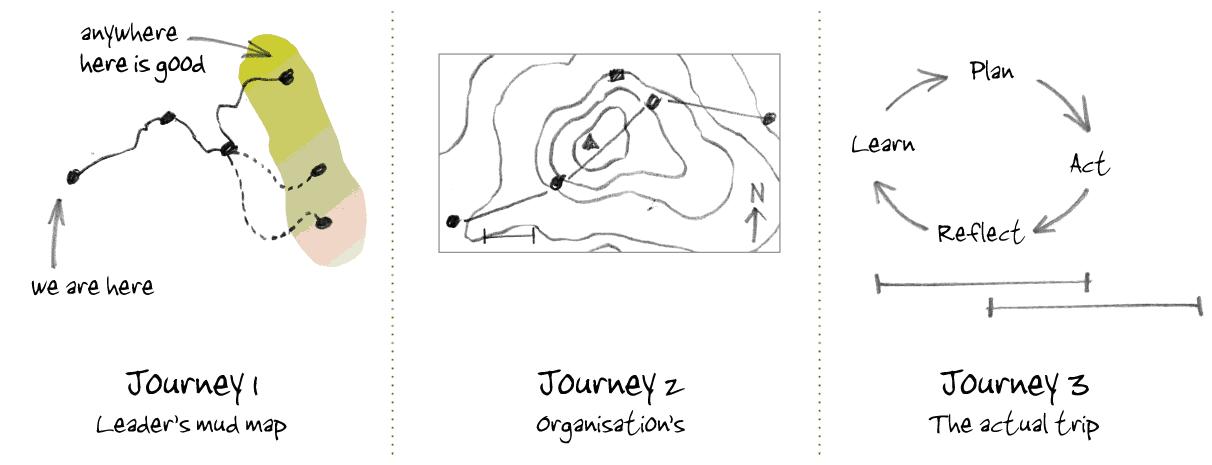
The second journey involves the rest of the organisation (or a representative subset) planning how they will get to the desired state. This involves understanding the current knowledge environment—who's connected to whom, where are the important knowledge assets, where are the blockers, what are the enablers—and developing the best possible map based on current information and resources available that can be made to guide the third journey.
The third journey is when the organisation actually embarks on implementing the ideas developed in the first two imaginary journeys. Most importantly in the third journey, the organisation implements an iterative process they designed in the second journey that embeds new knowledge-related behaviours and provides opportunities for new ideas to be injected in how things are done. For an example of what this might look like please refer to our recent blog post on the topic
(http://www.anecdote.com.au/archives/2007/02/redressing_the.html).
What do we mean by tacit knowledge?
In the knowledge management world there are two camps: one that believes tacit knowledge can be captured, translated, converted; and the other that highlights its ineffable characteristics. I must admit I was for a long time firmly ensconced in the latter category and our white paper on “How we talk about knowledge management” reflects this view. But I realise now it is simply impractical to adopt an either/or perspective and so I would like to propose a way forward that focusses on why knowledge is tacit (remaining unspoken, unsaid, implied, unexpressed) and then based on these reasons we can start thinking about the appropriate approach to capturing or transferring tacit knowledge.

I think the iceberg metaphor is useful. Below the waterline lies an organisation's tacit knowledge. Near the water surface lies tacit knowledge that's easier to work with but as we go deeper the nature of the tacit knowledge changes, it becomes murkier and harder to see and grasp. As we increase in depth we can think of the different reasons why our knowledge is unspoken.
Hasn't been recorded. Most organisations put their efforts in in dealing with this type of tacit knowledge. Probably because it's easy. “Let's find out what we know and then document it.” As a result wikis are popping up everywhere. Creating more explicit knowledge then creates a new problem of findability And as Peter Morville says, “what we find changes who we become.”
Will never be recorded. There are some things you know, that you could quite easily tell someone else, that you would never want to write down or be widely known. Imagine a diplomat who has an intimate knowledge of their counterpart's peccadillos in an allied government. Perhaps not the type of thing that would be written down. More benign examples include stuff ups and when people are breaking the rules for the right reasons (or even for the wrong reasons).
Too many resources required to record. Sometimes it just takes too much time and effort to write down what you know. For one thing, when you write it down you have to assume a broad audience (not like a conversation where you are assessing whether the person you are taking to is getting it), which makes the task even harder. Imagine Einstein walking in the room and someone without advanced physics knowledge asking him to explain the general theory of relativity. It would be impossible for Einstein to provide a comprehensive answer because his knowledge requires stimulation in order to be forthcoming. Dave Snowden encapsulates this idea in his aphorism, “you only know what you know when you need to know it.”
Everyone knows it (taken for granted). Now we are getting into the type of tacit knowledge that's more difficult to identify. This knowledge often represents the core values and beliefs in an organisation. It can manifest as metaphors. For example, I visited a investment bank in Sydney and their language revolved around gambling: “We can take a bet on that.” “Let's roll the dice and see what happens.” “Everyone was poker faced.” Another organisation was fixated with traffic metaphors: “It's a real roadblock.” “We got the green light.” “We have a clear roadmap now.” No one noticed how they were using these metaphors yet it guided their actions every day. I guess we call these things 'culture.'
Individuals don't know but groups do. Have you ever read Cognition in the Wild? It tells the story of the bridge crew of the aircraft carrier USS Palau and how together they can dock this enormous ship yet no single individual could describe how it is done. Many teams have this underrated and generally unrecognised this group-based ability.
Can't be recorded. Much of our tacit knowledge falls into this category. The effects of this type of tacit knowledge (some would say the only true tacit knowledge) are displayed in our action and therefore it's impossible to capture or convert it. The approach here is to become mindful and reflect of what is displayed—conversations, coaching, shadowing. Sure, we can video tape people undertaking tasks but time and time again practitioners have discovered there are qualities that are not captured and the task cannot be completed successfully. My favourite example is those white-coated gentlemen in France who test whether those humungous wheels of cheese have ripened. Using a little hammer they tap each one and know instantly which ones are ready to eat. How do they know? Is it the sounds, the bounciness, the smell? I recall a group of scientists set about to measure all these characteristics in order to create an automatic cheese ripeness testing machine but as hard as they might try they paled in comparison to the experience of the practised cheesemaker.
Posted by Shawn Callahan - 14/08/07
Filed in Knowledge.
I think the iceberg metaphor is useful. Below the waterline lies an organisation's tacit knowledge. Near the water surface lies tacit knowledge that's easier to work with but as we go deeper the nature of the tacit knowledge changes, it becomes murkier and harder to see and grasp. As we increase in depth we can think of the different reasons why our knowledge is unspoken.
Hasn't been recorded. Most organisations put their efforts in in dealing with this type of tacit knowledge. Probably because it's easy. “Let's find out what we know and then document it.” As a result wikis are popping up everywhere. Creating more explicit knowledge then creates a new problem of findability And as Peter Morville says, “what we find changes who we become.”
Will never be recorded. There are some things you know, that you could quite easily tell someone else, that you would never want to write down or be widely known. Imagine a diplomat who has an intimate knowledge of their counterpart's peccadillos in an allied government. Perhaps not the type of thing that would be written down. More benign examples include stuff ups and when people are breaking the rules for the right reasons (or even for the wrong reasons).
Too many resources required to record. Sometimes it just takes too much time and effort to write down what you know. For one thing, when you write it down you have to assume a broad audience (not like a conversation where you are assessing whether the person you are taking to is getting it), which makes the task even harder. Imagine Einstein walking in the room and someone without advanced physics knowledge asking him to explain the general theory of relativity. It would be impossible for Einstein to provide a comprehensive answer because his knowledge requires stimulation in order to be forthcoming. Dave Snowden encapsulates this idea in his aphorism, “you only know what you know when you need to know it.”
Everyone knows it (taken for granted). Now we are getting into the type of tacit knowledge that's more difficult to identify. This knowledge often represents the core values and beliefs in an organisation. It can manifest as metaphors. For example, I visited a investment bank in Sydney and their language revolved around gambling: “We can take a bet on that.” “Let's roll the dice and see what happens.” “Everyone was poker faced.” Another organisation was fixated with traffic metaphors: “It's a real roadblock.” “We got the green light.” “We have a clear roadmap now.” No one noticed how they were using these metaphors yet it guided their actions every day. I guess we call these things 'culture.'
Individuals don't know but groups do. Have you ever read Cognition in the Wild? It tells the story of the bridge crew of the aircraft carrier USS Palau and how together they can dock this enormous ship yet no single individual could describe how it is done. Many teams have this underrated and generally unrecognised this group-based ability.
Can't be recorded. Much of our tacit knowledge falls into this category. The effects of this type of tacit knowledge (some would say the only true tacit knowledge) are displayed in our action and therefore it's impossible to capture or convert it. The approach here is to become mindful and reflect of what is displayed—conversations, coaching, shadowing. Sure, we can video tape people undertaking tasks but time and time again practitioners have discovered there are qualities that are not captured and the task cannot be completed successfully. My favourite example is those white-coated gentlemen in France who test whether those humungous wheels of cheese have ripened. Using a little hammer they tap each one and know instantly which ones are ready to eat. How do they know? Is it the sounds, the bounciness, the smell? I recall a group of scientists set about to measure all these characteristics in order to create an automatic cheese ripeness testing machine but as hard as they might try they paled in comparison to the experience of the practised cheesemaker.
Posted by Shawn Callahan - 14/08/07
Filed in Knowledge.
Subscribe to:
Posts (Atom)